
Showing posts with label World issues. Show all posts
Showing posts with label World issues. Show all posts
Friday, 4 December 2009

Friday, 27 November 2009
Broadband access for all

EU call for 'universal' broadband
Brussels is considering making broadband access available for all.
The fast growth of broadband has led the European Commission to bring forward a review of the basic telecoms services Europeans can expect.
Current statistics suggest about 36% of households in EU member nations have high-speed net access.
When a majority of EU citizens are using a telecoms service, EC rules dictate that it becomes one every European should be able to enjoy.
Basic access
"High-speed internet is the passport to the Information Society and an essential condition for economic growth," said Viviane Reding, EU Telecoms Commissioner in a statement announcing the review.
"This is why it is this Commission's policy to make broadband internet for all Europeans happen by 2010."
The EC's Universal Service Obligations (USO) demand that all citizens who want them should be able to get access to basic telephone services.
It covers the production of a telephone directory, availability of payphones, specific measures for people with disabilities or those on low incomes and fixed phone access for local, national and international voice calls.
The obligations also include a clause demanding that the fixed line be of sufficient quality to "permit functional internet access". In the UK this has been interpreted to mean a line that can support a dial-up speed of 28.8 kilobits per second.
The EC reviews the USO every three years and in its report kicking off the latest overhaul, it said broadband was growing at a pace that would mean more Europeans were using it than not.
Figures from the EC suggest that from 2003-2007 broadband use in member nations tripled to 36% of households and had an annual growth rate of 20%.
Despite this, said the EC, there were "striking gaps" among member states and the coverage their citizens enjoyed.
In nations such as Denmark, Luxembourg and Belgium, 100% of the population can get broadband if they want it. By contrast, 60% of Romanians cannot get broadband access.
Even in nations such as Germany and Italy, which have booming broadband sectors, about 12% of the population is not covered by high-speed access.
The review aims to find out if the USO needs to be re-written to force telecoms firms to extend broadband to those areas competition will leave bereft of it.
It will also find out if a narrow-band access, aka dial-up, is sufficient to "permit functional internet access" or if the pace of change online means higher speeds are the minimum needed.
The EC is inviting submissions from telecoms firms, governments and citizens with the aim of producing a communique in 2009 and perhaps legislation in 2010.
20 questions on genetically-modified (GM) foods

Q1. What are genetically modified (GM) organisms and GM foods?
These questions and answers have been prepared by WHO in response to questions and concerns by a number of WHO Member State Governments with regard to the nature and safety of genetically modified food.
Genetically modified organisms (GMOs) can be defined as organisms in which the genetic material (DNA) has been altered in a way that does not occur naturally. The technology is often called “modern biotechnology” or “gene technology”, sometimes also “recombinant DNA technology” or “genetic engineering”. It allows selected individual genes to be transferred from one organism into another, also between non-related species.
Such methods are used to create GM plants – which are then used to grow GM food crops.
For the other questions, please click this link and go to the WHO's website.
Thursday, 26 November 2009
What is digital divide?
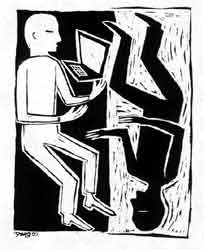
The concept of the digital divide is becoming more and more complex as access to computers and the use of computers, changes over time. When the existence of a “digital divide” first emerged, it revolved around access to computers and related technologies. The high cost of computers create a large divide between people who could afford them, and who had access to all the advantages of a computer, and those who could not.
The falling cost of computers, combined with initiatives in many countries to create community access points or telecentres [link], has meant that more and more people are gaining access to some form of computer. As more people gain basic access to computers, the term “digital divide” has grown to encompass technological literacy and the total cost of running a computer—in other words, the ability, both technical and financial, to make full use of the technology available. The digital divide now takes into consideration access, or lack of access, to the Internet, as well. The digital divide is not only an issue in developing countries. Even in very wealthy countries, various communities face barriers to access, for economic, linguistic, and even generational reasons.
Some organizations and even countries are trying to close the digital divide using free and open source software (FOSS). FOSS allows anyone to modify the software for his or her needs. One common reason to turn to FOSS is language: many software programs do not include language support for more than three or four languages. FOSS programmers can provide translation and localization for the software by changing the software code. To do this with non-open source, or proprietary, software users must wait until the company who made the software translates it.
Different groups are trying to close the digital divide in many other ways. The World Summit on the Information Society was a global policy process where governments, civil society, and businesses tried to solve some of the most pressing issues, ranging from basic access to who controls the flow of information on the Internet (Internet governance and net neutrality). There is also a large group of individuals, called the Digital Divide Network (DDN) [link] who are trying to close the divide in a number of different and innovative ways.
TakingITGlobal.
Subscribe to:
Posts (Atom)

 Posts
Posts


